- May 18
Where Words End: An Introduction to AuditiveCoaching©
- ConAquila Akademie
- AuditiveCoaching, Coaching, Mindfulness
- 0 comments
By Martina M. Schuster — Founder of the ConAquila Akademie and boxofhappiness.academy, developer of AuditiveCoaching©
I. The moment language stops working
There are moments in every coaching journey where words fall short. A client circles the same issue. They return to the same edge, name the same insight, and yet — something deeper hasn't moved. The mind has understood. The body has not.
If you have been coaching for any length of time, you know these moments. They are the ones that mark the difference between a method and a methodology of presence. The questions you ask are good. The frameworks you hold are sound. And still, the room reaches a quiet limit.
This is not a failure of the coach. It is a feature of how human beings are built.
II. Why words sometimes don't reach
A great deal of what shapes a person's life never arrives in language. The earliest layers of memory, the imprints of safety and danger, the rhythms of attachment, the cellular sense of "I" — all of these are encoded long before words exist. They live in the nervous system, in the breath, in the body's pre-verbal intelligence.
When a client sits across from you and cannot find the next word, it is often because the next word doesn't exist. Not yet. The material wants to move, but it doesn't want to speak. It wants to be met.
This is the territory where sound, music, and the human voice begin to do something that conversation alone cannot.
Sound speaks directly to the nervous system. A held note, the right frequency, a quiet hum, can shift a state in seconds. The voice — the client's own voice, even more than the coach's — becomes an instrument of presence and recognition. It allows what has been waiting beneath language to finally make itself known.
This is the foundation of AuditiveCoaching©.
III. How AuditiveCoaching© came to be
People sometimes ask me how a method like this could emerge from a background like mine. I understand the question. On paper, it is an unusual line of inheritance.
I studied business administration at university and graduated as a Diplom-Kauffrau, with focus areas in marketing, banking, and systems research. I extended my studies interdisciplinarily into psychology — market and perceptual psychology, organisational and work psychology. For twelve years, I served as co-founder and board member of an internationally operating high-tech company. I met teams across cultures, built businesses, and sat in rooms where strategic decisions had consequences for people.
And at the same time, I have always sung. I sing arias. I sing jazz. I trained as a music therapist. Sound, voice, and resonance have always been the other thread of my life — not a hobby, but a second mother tongue.
For years, these two worlds stayed politely separate. The business world spoke in language and structure. The musical world spoke in resonance. And then, somewhere in the work with clients, the wall between them dissolved. I noticed that the moments of real breakthrough were rarely the moments of cleverest insight. They were the moments when something moved — in the breath, in the body, in the room.
I began, very carefully, to let sound enter the coaching process. A held tone. A single note. The client's own voice, gently invited. The shifts were unmistakable.
AuditiveCoaching© is what emerged from those years of quiet experiment. It is a coaching method that integrates music, sound, and the human voice with the established frameworks of professional coaching — constructivist thinking, NLP, systemic work, organisational psychology, perception psychology. Not as decoration. As a working core.
IV. What the method actually does
AuditiveCoaching© works on three levels at once.
On the body, sound regulates. Specific frequencies and vocal practices calm the autonomic nervous system, deepen the breath, and bring a client out of fight, flight, or freeze. This is not metaphor. It is measurable physiology. A client who arrives in chronic activation cannot access their resources, no matter how good your questions are. Sound creates the physiological conditions under which coaching can actually land.
On the emotional level, sound makes feeling visible. Emotions that have no language — grief that is too old, fear that has no story, joy that has been forgotten — can be expressed through tone before they can be named. The voice carries what words cannot, and once a feeling has been sounded, it can be looked at. It is no longer trapped.
On the mental level, sound interrupts pattern. Old thought loops are held together by familiar rhythms. A new sound, a new vocalisation, a moment of resonance, breaks the rhythm and creates space for a different perspective to arrive. Clients often describe this as "suddenly knowing what to do" — but what has actually happened is that the system has unhooked from its loop.
Across all three levels, the coach stays in a clear professional role. The client is always the agent. The sound is never imposed. AuditiveCoaching© is, in this sense, deeply ethical: the client can decline any sonic element at any moment, and the method works equally well in subtle and explicit forms.
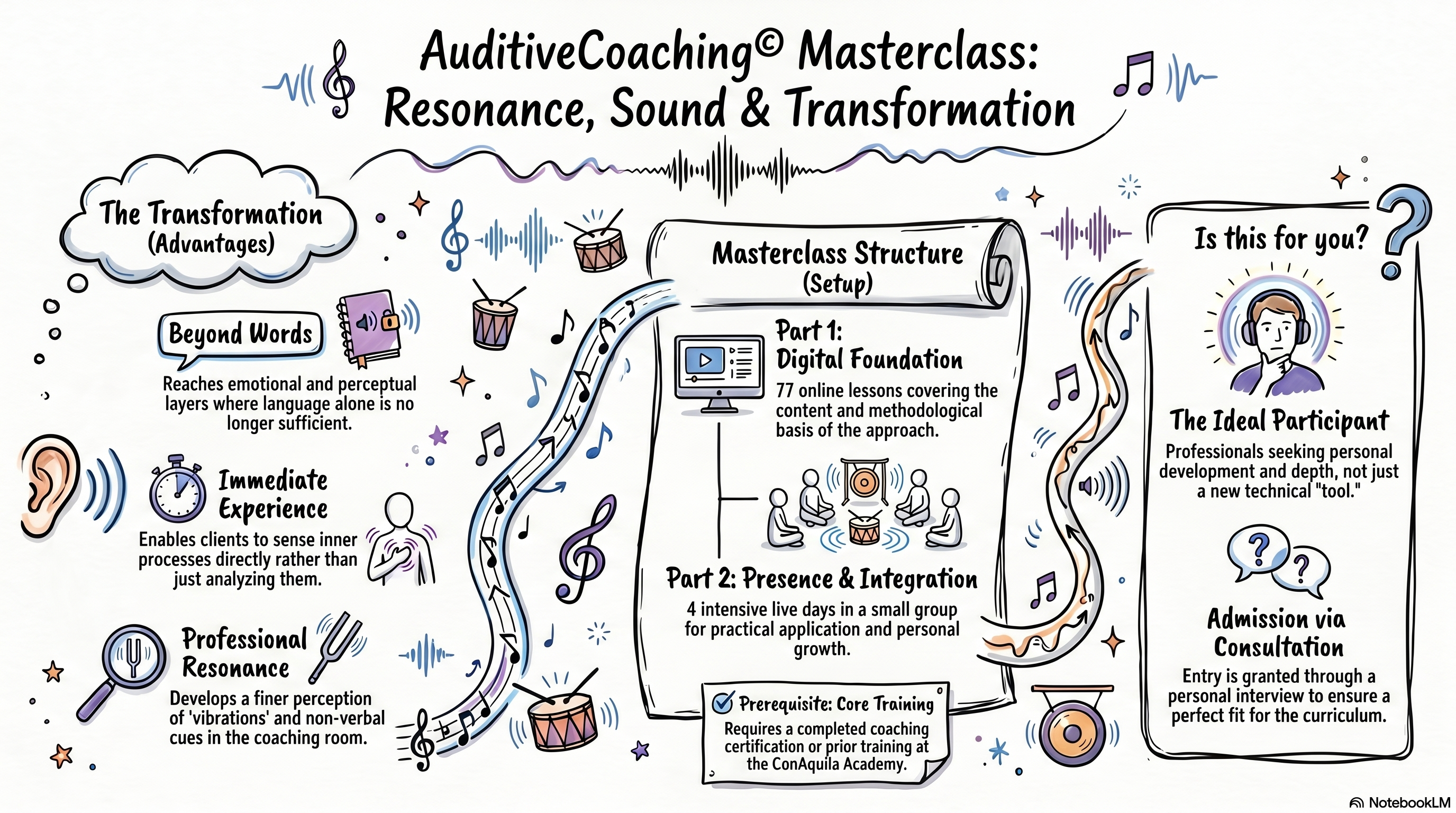
V. Who the Masterclass is for
The AuditiveCoaching© Masterclass is not an introductory training. It is an advanced specialisation for coaches and therapists who already have a stable foundation in their work, and who feel — quietly, but persistently — that there is more.
It is for you if you have noticed that some of your most meaningful sessions have a non-verbal quality you can't quite name. If you are drawn to the idea of working with sound, voice, or resonance but want a method, not a vibe. If you want a specialisation that gives your practice a distinctive signature in a crowded market. If you want depth, not certificates.
The format combines four intensive days in person, 77 online lessons available on the learning platform, and twice-weekly live mentoring sessions where you can bring your real questions and your real client work. It concludes with certification.
You leave with a method you can apply on Monday morning. You also leave changed — because no one teaches sound work without going through it themselves.
VI. A closing reflection
I did not set out to invent a method. I set out to do work that mattered, in a way that was honest to who I am.
What I have learned, over seventeen years of running my academy and refining this approach, is that the coaches who choose AuditiveCoaching© tend to be people who have always sensed that real transformation lives somewhere beneath the conversation. They were waiting for permission to bring their full instrument into the room.
If that is you, you are not alone, and you are not late.
Sound has been used for healing for as long as humans have existed. What is new is the integration: a clean, professional, contemporary coaching method that takes sound seriously, takes coaching seriously, and refuses to compromise either.
If you would like to know more, the next AuditiveCoaching© Masterclass dates are listed on the academy site. You are warmly invited to read more, listen in on boxofhappiness.radio, or reach out directly.
The work is waiting.
Warmly, Martina M. Schuster Founder, ConAquila Akademie & boxofhappiness.academy Developer of AuditiveCoaching©
© Martina M. Schuster
Plants talk to us
Listen!
AuditiveCoaching© - Coaching with Music, Sound and Song
Discover the power of sound in coaching – awaken presence, intuition, and transformation through AuditiveCoaching©.